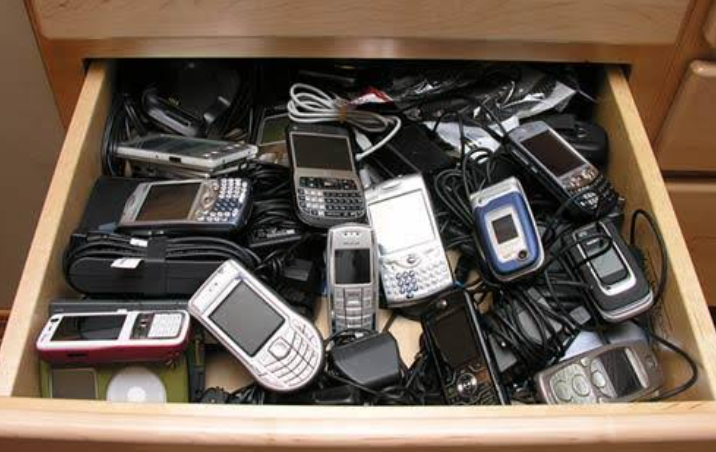

Almost every household has one. A drawer, a shoebox, or a corner of a cupboard containing two or three or six phones that were replaced but never dealt with. They are kept partly out of vague caution, in case the current phone fails, and partly because nobody is quite sure what the alternative is.
The scale of this is genuinely large. Estimates consistently suggest that billions of unused phones are sitting idle in homes worldwide, holding a considerable quantity of gold, silver, copper, cobalt, and rare earth elements that were mined at real cost and are now doing nothing. The lithium cells inside them are also slowly degrading, and a swollen battery in a forgotten drawer is a genuine fire risk rather than a theoretical one.
The reasons people hesitate are understandable and mostly solvable. Concern about personal data is the most common, followed by uncertainty about whether an old device has any value and confusion about where it can actually be taken. Sorting out those three questions is what turns old cell phone recycling from a vague intention into something that gets done on a Saturday morning.
Dealing With Your Data Properly
This deserves attention because a phone typically holds more personal information than any other device a person owns: messages, photos, location history, saved passwords, banking apps, and authentication tokens.
Start by backing up anything you want to keep, then check the backup actually contains it before going further. Recovering something afterwards is not always possible.
Sign out of accounts explicitly rather than relying on a reset to handle it. Remove the device from your account on each major service, because account locks tied to the device can persist through a factory reset and will render the phone useless to anyone else, which defeats the purpose if the device is otherwise reusable.
Disable device tracking features and remove the phone from your list of trusted devices, particularly if it has been used for two factor authentication. Then perform a factory reset. Modern phones encrypt storage by default, and a factory reset destroys the encryption key, which renders the remaining data unrecoverable in practice.
Finally, remove the SIM card and any memory card. These are easy to forget and they travel with the device if left in place.
Working Out Whether It Is Worth Anything
Devices that are only a few years old and still functional often carry meaningful trade-in value. Condition drives the number more than anything else, with screen condition and battery health mattering most.
Trade-in programs from manufacturers and carriers are the simplest route and usually pay in credit rather than cash. Independent buyback services often pay more, in actual money, but require shipping and a condition assessment. Private sale generally yields the highest return and involves the most effort and the most risk.
If the phone is older than about five years, has a cracked screen, or no longer holds charge, resale value is usually minimal. That is not a reason to keep it in a drawer. It is the point at which recovery becomes the sensible destination rather than resale.
Devices that are two or three years old and working are frequently worth passing on directly. Family members, community programs, and organizations that refurbish devices for people who cannot afford new ones all put working phones back into use, which is a better outcome than material recovery.
Where Devices Can Actually Be Taken
Carrier stores and manufacturer retail locations generally accept devices regardless of brand or condition, and this is the lowest friction option for most people.
Municipal collection depots accept phones alongside other electronics, though they typically will not handle data considerations and are best used for devices you have already reset.
Charitable programs collect phones for refurbishment and redistribution, and several are structured to support specific causes.
Dedicated processors are the right choice for anything in volume, for damaged devices, and for anyone who wants documented handling. If a business is clearing out a stock of retired handsets, this is the category worth approaching rather than a retail counter.
The Battery Question
Lithium cells warrant a specific note. A phone that has been sitting unused for years may have a swollen battery, which shows as a bulging back panel, a lifted screen edge, or a device that no longer sits flat.
Do not press on it, puncture it, or attempt to remove it yourself. Do not put it in general waste under any circumstances. Take it to a collection point and tell staff about the swelling so it can be handled in a fire-rated container.
This is the one situation where leaving a device in a drawer is actively worse than dealing with it, because the risk increases as the cell continues to degrade.
Making It a Habit Rather Than a Project
The reason drawers fill up is that each individual phone never feels urgent enough to act on. The fix is to attach the decision to the moment of replacement rather than treating it as a separate task later. When a new phone is set up, deal with the old one in the same week: back up, sign out, reset, and either trade in, pass on, or drop off.
Handled that way, it takes twenty minutes and the drawer never fills up again. Handled the usual way, it becomes a box of aging batteries that someone will eventually have to deal with anyway, with less value left in it and more risk attached.

 By
By