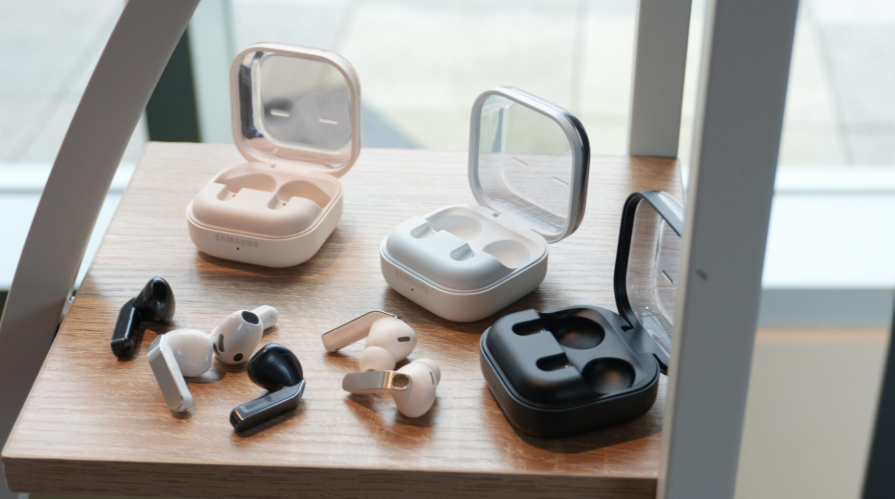

The modern corporate workspace is no longer defined by quiet boardrooms and isolated offices. In an era dominated by remote execution, hybrid structures, and global digital collaboration, an executive’s primary terminal is frequently an active airport lounge, an open-concept workspace, or a vehicle during transit. Within this dynamic environment, the metric for communication hardware viability has fundamentally shifted. It is no longer enough for an audio accessory to merely reproduce sound; it must act as a precise data pipeline that can isolate human speech from chaotic environments.
Achieving absolute voice clarity across digital platforms like Microsoft Teams, Zoom, and unified cellular loops requires sophisticated processing. The true wireless stereo (TWS) market addresses this need through two primary form factors: the Galaxy Buds 4 Pro and the Galaxy Buds 4. By analyzing the deployment of specialized micro-amplifiers, hardware-level voice pickup arrays, and advanced machine-learned Deep Neural Networks (DNN) working over Super Wideband (SWB) channels, we can see how modern engineering maintains pristine corporate voice clarity under extreme acoustic conditions.
The Architecture of the Audio Capture Matrix
To transmit a clean voice signal across digital channels, an earbud must first solve the mechanical problem of localized audio capture. Human speech generates acoustic pressure waves that move quickly outwards from the mouth, but these waves are easily drowned out by ambient noise like wind shear, mechanical ventilation, or nearby cross-talk.
To combat this, both models use an advanced 3-microphone array embedded into an aerodynamic stem profile known as the blade design. Each earbud features two external High Signal-to-Noise Ratio (HSNR) microphones and one internal microphone positioned inside the ear shell. The external units act as a directional beamforming tracker, using calculated time-of-arrival variances to pinpoint the user’s mouth while actively dampening sound originating from the sides or rear.
The internal microphone serves an entirely different purpose: it monitors the closed environment of the ear canal itself, capturing low-frequency vocal resonances that travel through the throat and jaw.
On the Pro model, this acoustic framework is further reinforced by an integrated hardware Voice Pickup Unit (VPU) linked to a localized bone conduction sensor. When the user speaks, their jaw bone moves in tiny kinetic vibrations that bypass the air entirely. The VPU registers these physical movements directly, providing a pure, non-acoustic data reference of the user’s speech rhythm. Even if external air noise reaches extreme levels, the bone-conduction tracking provides an immutable baseline for the internal processing chips, ensuring the device can instantly verify which sounds belong to the speaker.
Machine-Learned Isolation via Deep Neural Networks
Once the audio capture matrix registers the raw sound data, the system relies on local computational processing to refine the signal. Traditional audio accessories used simple high-pass filters or basic noise gates to manage noise. While effective at blocking continuous, predictable hums like airplane cabins, those old systems often failed against sudden, erratic noise spikes like shattering glass, typing clicks, or background conversations, often warping the user’s voice into an artificial, metallic distortion.
Both tiers address this issue by incorporating a specialized Deep Neural Network (DNN) directly into their internal audio processors. This machine-learned engine has been trained on a database containing millions of distinct audio samples, teaching the software to cleanly differentiate between human speech patterns and unpredictable environmental noise.
During a voice call, the DNN acts as a real-time digital filter running on each earbud. The algorithm constantly scans the incoming audio data streams, mapping out the precise frequencies that contain the speaker’s natural vocal tones. It then isolates and strips away unpredictable background artifacts—such as keyboard clicks in a busy cafe, wind rushing across a train platform, or street noise—while preserving the authentic tone and depth of the speaker’s voice. This advanced processing ensures that remote clients or internal team members hear a clean, clear voice signal, eliminating the listening fatigue caused by static or distracting background noise.
Dual Micro-Amplification and Driver Dynamics
While transmitting a clear voice signal is a core requirement for remote calls, delivering pristine incoming audio to the user is equally critical for productive corporate collaboration.
The standard model uses a streamlined configuration built around a single 11mm dynamic wide-range driver powered by a single amplifier channel. This setup provides clean, well-balanced sound reproduction across standard communication frequencies, offering clear vocal presence for virtual meetings and general streaming.
The Pro model features a two-way speaker system designed to maximize detail and reduce distortion. It separates audio frequencies across two specialized hardware layers: an 11mm dynamic super-wide woofer with an expanded diaphragm area for deep low-end frequencies, and a dedicated 5.4mm planar tweeter for handling delicate, high-frequency details.
Crucially, this dual-driver layout is driven by an independent dual-amplifier system. By assigning a dedicated micro-amplifier to power each driver separately, the device eliminates intermodulation distortion—a common issue where heavy low-frequency tones bleed into and muddy the mid-and-high frequencies. This meticulous tuning ensures that during multi-party conference calls, every individual voice line remains cleanly separated and distinct, allowing users to catch subtle vocal inflections and follow fast-paced discussions effortlessly.
Super Wideband Telecommunication Pipelines
The final step in optimizing voice clarity involves managing data transmission across wireless connections. Standard Bluetooth phone connections often bottleneck audio quality, compressing voice data down to a narrow 8 kHz frequency ceiling. This aggressive compression strips away the natural textures of human speech, making voices sound thin, flat, and hard to distinguish.
Both premium earbud tiers bypass this bottleneck by leveraging Super Wideband (SWB) call processing technology over an optimized Bluetooth 6.1 framework. When paired with a compatible ecosystem device, the communication pipeline expands the voice data bandwidth up to a wide 16 kHz frequency threshold.
By doubling the available data space for voice transmission, the system captures complex high-frequency speech details and subtle vocal dynamics that traditional wireless systems compress away. This high-definition pipeline allows consonants like “s,” “f,” and “t” to remain sharp and distinct, preventing miscommunications during critical contract reviews or strategic planning sessions.
The software also implements Personalized Beamforming data loops that match the specific direction of the user’s head relative to their phone, ensuring data transmission remain completely stable and stutter-free even in crowded areas with high wireless signal interference.
See also: How a Car Accident Lawyer Centennial Can Help After a Serious Crash
Software Integration and Long-Term Value Lifecycle
Beyond their physical components, these premium accessories gain considerable utility through deep software integration with the broader system ecosystem. Running on the One UI interface, both models feature immediate pairing and centralized control options, allowing users to configure audio profiles directly from their main device menus without relying on third-party companion software.
The platform includes useful smart features designed to ease everyday workflow transitions:
- Voice Detect Automation: Available on the Pro model, this system automatically shifts the earbuds out of Active Noise Cancellation into an ambient transparency mode the moment you start speaking, allowing for smooth, face-to-face interactions with office colleagues without requiring you to remove the earbuds.
- Intelligent Siren Detection: The Pro model’s safety monitoring system listens for emergency warnings or alarms, automatically adjusting sound settings to keep you aware of critical environmental events.
- Real-Time Language Interpretation: Both earbud options interface directly with system-level translation tools to deliver spoken translations directly into your ear during face-to-face international meetings via Galaxy AI interpreter modes.
For environmental durability, the standard model carries an IP54 dust and splash resistance rating that easily handles intense gym workouts and daily commutes. The Pro model steps up protection to an IP57 dust and waterproof rating, meaning the internal electronics remain completely protected even if dropped into water during a hectic transit schedule.
Backed by continuous system performance refinements, both versions serve as highly capable, long-term communication assets designed to maintain absolute professional clarity in any environment.
Selecting Your Corporate Audio Interface
Choosing the ideal wireless audio tool requires matching your specific daily routine with the proper functional hardware path:
- The Streamlined Ergonomic Track: The standard model delivers high everyday performance in an open, unsealed design that eliminates ear pressure, combining sharp 16 kHz voice call pipelines and smart machine-learned noise reduction in a lightweight form factor optimized for all-day comfort.
- The Absolute Isolation Track: The Pro variant serves as an uncompromised professional tool, delivering a complete in-ear acoustic seal, dual-amplified dual drivers for ultimate precision, an integrated bone-conduction VPU, and robust IP57 weather protection engineered for demanding travel schedules.
By pairing advanced local computational algorithms with clear wireless data tracking across both physical configurations, this generation of audio accessories provides reliable, high-performance communication nodes tailored for the evolving requirements of the modern enterprise landscape.

 By
By