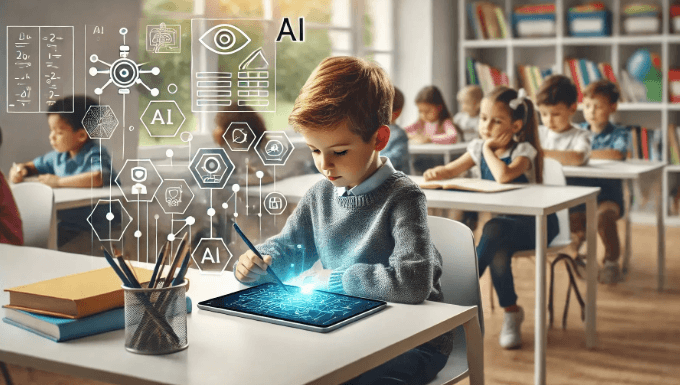

Artificial intelligence has moved quickly from an emerging technology to something students and educators encounter in everyday learning. AI-powered tools can explain difficult concepts, generate practice questions, provide writing feedback, support language learning, and help teachers organize certain administrative tasks. At the same time, schools are working through important questions involving academic integrity, privacy, accuracy, accessibility, and the appropriate role of technology in the classroom.
This shift is changing education in ways that go beyond simply giving students another digital tool. Teachers are reconsidering assignments, schools are developing AI policies, and students are learning that using artificial intelligence effectively requires judgment rather than simply accepting whatever a system produces. The most useful applications tend to support the learning process instead of replacing it. As AI becomes more common, education is gradually moving toward a model where knowing how to question, evaluate, and responsibly use technology becomes part of being an informed learner.
Personalized Learning Becomes More Practical
A classroom may contain students who understand the same lesson at very different speeds. One student might need another explanation of fractions, while another is ready to apply the concept to a more challenging problem. Teachers have always adapted instruction where possible, but providing completely individualized support to every student throughout the day is difficult.
AI can help provide another layer of assistance.
Some educational systems can adjust practice activities according to student performance. If a learner repeatedly struggles with one concept, the system may provide additional exercises or explanations. A student who demonstrates understanding may move toward more advanced material.
Generative AI introduces additional possibilities because students can ask questions using natural language. Someone confused by a complicated explanation might request a simpler version, ask for an analogy, or request a practice problem.
This flexibility can be valuable, although students still need to recognize that AI-generated answers can contain mistakes. Teachers remain essential for providing context, identifying misconceptions, and determining whether students genuinely understand what they are learning.
Teachers Are Finding New Ways to Use AI
Artificial intelligence is changing teachers’ work as well as students’ experiences.
Educators may use AI-assisted tools to brainstorm lesson activities, develop examples, create preliminary quiz questions, adjust reading materials, or generate ideas for classroom discussions. Certain technologies can also support administrative work, giving teachers more time to concentrate on instruction and direct student interaction.
The key is professional oversight. A generated worksheet still needs to be reviewed for accuracy and appropriateness. A suggested lesson activity may need significant adjustment for a particular age group or curriculum.
Teachers understand their students in ways software cannot. They know when a class is confused, when a discussion deserves more time, and when a student needs encouragement rather than another automated explanation.
Used carefully, AI can function as an assistant that helps educators prepare and organize. The teacher remains responsible for deciding what belongs in the classroom.
That distinction will remain important as educational technology becomes more capable.
Understanding AI for Students
The growing availability of AI for students creates opportunities to make studying more interactive and individualized when these tools are used responsibly. AI for students can support activities such as generating practice questions, explaining unfamiliar terminology, reviewing concepts, brainstorming research directions, practicing another language, or providing feedback that helps learners revise their own work.
The most productive approach is to use AI as a learning partner rather than a shortcut around learning. Asking a tool to explain why an answer is incorrect can strengthen understanding. Asking it to complete an entire assignment may eliminate the very thinking the assignment was designed to develop.
Students also need to verify important information through reliable sources and follow the AI policies established by their teachers or schools.
Assignments Are Beginning to Change
Generative AI has forced educators to reconsider what certain assignments actually measure.
A traditional take-home essay once provided a relatively straightforward opportunity for students to demonstrate writing and research skills. Today, a generative system can produce a polished-looking response in seconds. That does not make writing assignments obsolete, but it does encourage teachers to design work that reveals more of the student’s thinking.
Some educators are placing greater emphasis on drafts, source evaluation, classroom discussion, oral explanations, personal reflection, and documentation of the research process.
Students may be asked to explain why they selected particular evidence or how their argument changed during revision. These activities make the learning process more visible.
AI can even become part of the assignment. A class might examine an AI-generated response, identify inaccuracies, evaluate its reasoning, and rewrite weak sections.
In that setting, students are not merely consuming artificial intelligence. They are learning to critique it.
Critical Thinking Matters More, Not Less
One concern surrounding AI is that students could become dependent on technology for answers. That risk is real, but it also highlights why critical thinking is becoming increasingly valuable.
Generative AI systems can produce responses that sound confident even when information is incomplete, misleading, or incorrect. Students therefore need to ask basic but important questions: Where did this information come from? Can I verify it? Is the source trustworthy? Does another credible source support the claim?
These habits have always mattered in education. AI simply makes them harder to avoid.
Students also need to recognize the difference between generating information and understanding it. Reading an AI-produced explanation of a mathematical process is not the same as being able to solve the problem independently.
Schools that teach students to question outputs, verify evidence, and recognize uncertainty can help prepare them for a world in which AI-generated information will likely appear far beyond the classroom.
Academic Integrity Is Being Redefined
Schools are also navigating difficult questions about acceptable AI assistance.
The appropriate use can vary considerably between assignments. A teacher might permit AI for brainstorming while prohibiting generated paragraphs. Another assignment may allow students to use AI but require them to document how it contributed to their work.
Clear expectations are therefore important.
Simply banning every AI tool may become increasingly difficult as artificial intelligence is incorporated into search engines, productivity software, educational platforms, and everyday applications. At the same time, unrestricted use can interfere with learning if students outsource important thinking.
Schools need policies that distinguish assistance from substitution.
Students benefit when they understand why certain tasks must be completed independently. The purpose of solving a problem, writing an essay, or analyzing a source is not merely producing a finished answer. The process itself develops skills.
Accessibility Could Become an Important Benefit
AI-powered tools may also improve access to educational materials for some learners.
Text-to-speech and speech-to-text technologies can provide alternative ways to interact with information. Translation tools may help multilingual students understand unfamiliar material, while adaptable explanations can present difficult concepts using different levels of complexity.
Students can sometimes request examples connected to familiar interests, making abstract subjects easier to approach.
These technologies should not be assumed to solve every accessibility challenge, and schools still need qualified educators and specialists who understand individual student needs. Privacy and accuracy also require careful consideration.
Still, the ability to present information through multiple formats represents a meaningful opportunity.
Education has long benefited from recognizing that students do not all learn in the same way. AI could expand the number of practical options available to support that principle.
Privacy and Responsible Use Need Attention
AI in education involves more than deciding whether a tool improves learning. Schools must also consider what happens to information entered into digital systems.
Students, particularly minors, may generate sensitive educational data. Schools need to evaluate technology providers carefully and understand applicable privacy requirements, data retention practices, security protections, and how submitted information may be used.
Teachers and students should also avoid entering sensitive personal information into tools that have not been approved for such use.
Bias represents another concern. AI systems learn from large collections of information and may reproduce limitations or biases found within their underlying data and design.
These challenges do not necessarily mean schools should avoid AI. They mean adoption should be deliberate rather than driven simply by novelty.
Educational value, privacy, security, fairness, and transparency all deserve consideration.
Preparing Students for an AI-Influenced Future
Perhaps the largest educational change involves what students need to know before entering college, careers, and adult life.
AI is already appearing in fields ranging from software development and marketing to science, manufacturing, healthcare, and finance. Future workers may frequently collaborate with systems that help analyze information, generate ideas, automate repetitive processes, or support decision-making.
Schools therefore face a balancing act. Students still need foundational knowledge, writing ability, mathematical understanding, creativity, communication skills, and independent reasoning. At the same time, they increasingly need AI literacy.
Knowing how to formulate a useful question, evaluate an automated response, verify information, recognize limitations, and decide when not to use AI may become valuable skills in their own right.
The strongest education will likely combine traditional intellectual skills with thoughtful technological fluency.
Education Is Changing, but Learning Still Matters
Artificial intelligence is changing the tools available to students and teachers, but the fundamental purpose of education remains familiar. Students need to develop knowledge, curiosity, judgment, creativity, and the ability to think independently.
AI can contribute to that process when it provides another explanation, creates useful practice, improves accessibility, or helps educators spend more time on meaningful teaching. It becomes less helpful when it replaces the intellectual effort students need to grow.
The challenge for schools is not simply deciding whether AI is good or bad. It is determining where the technology genuinely improves learning and where human instruction, independent effort, and traditional methods remain more appropriate.
As that balance develops, classrooms will continue changing. The schools that adapt successfully will likely be those that treat AI neither as a miracle solution nor as something to fear, but as a powerful tool that students must learn to use with curiosity, responsibility, and a healthy willingness to question the answers it provides.

 By
By